Is My British Shorthair Overweight? How to Actually Tell (and Why It Matters)
"How to tell if your British Shorthair is overweight using the vet-approved rib check and body condition score — plus why this breed is hard to judge by sight."
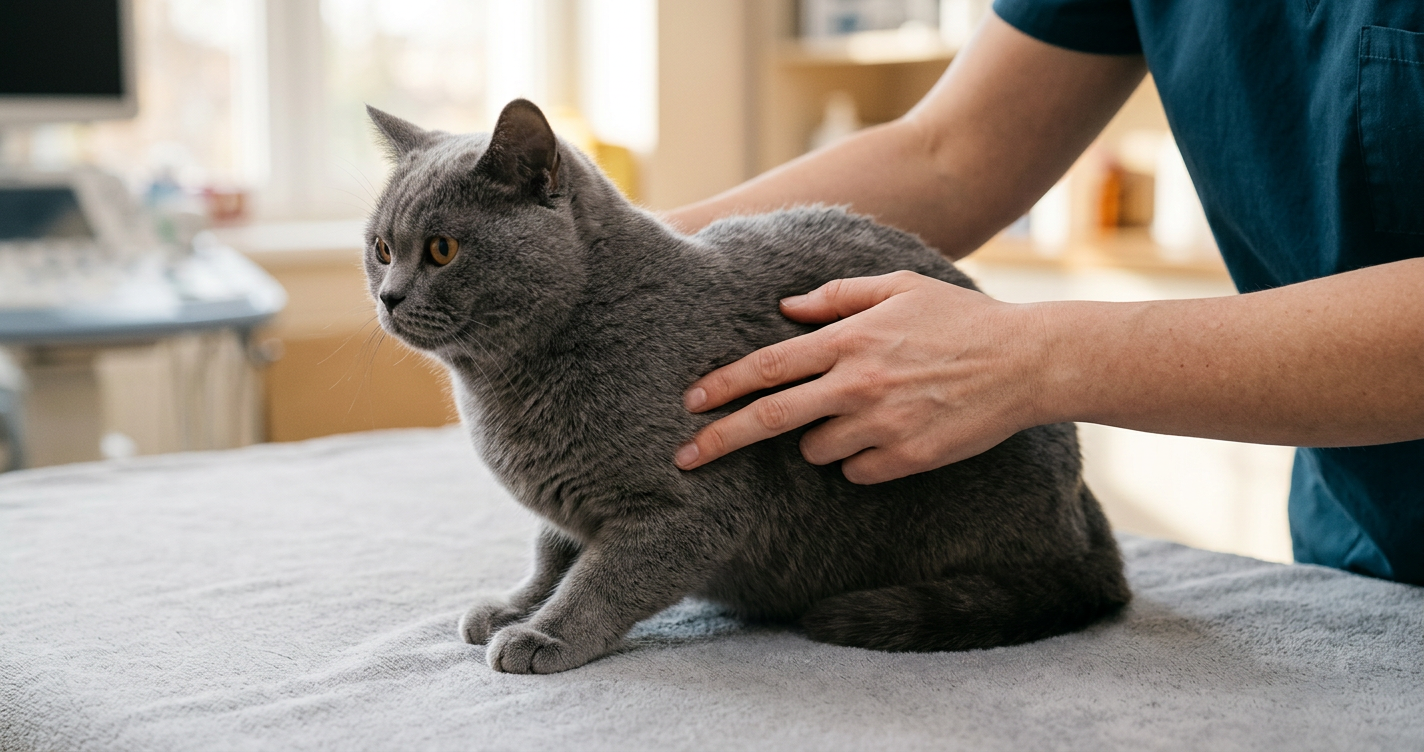
The Worry
When one owner brought her British Shorthair to the vet for a routine check, she came home with a weight-loss recommendation and a question she hadn't been prepared to answer. "I think I see a waist," she wrote on TheCatSite, "but I can't really feel her ribs. I don't know whether it's because her fur is so thick that I can't feel it." She had done her research before the appointment, knew that the breed was naturally stocky, knew that females could look chunky and still be healthy. She still left uncertain. Another owner, whose neutered male Teddy came in at 6.2 kg, had the same experience from the opposite direction: his vet was concerned and wanted the cat down to 4.5–5 kg. The owner had read that males could reach 7 kg or more. "I think 4.5kgs seems quite a low weight for an adult male British Shorthair," he wrote, "and seems to be at odds with breeder recommendations."
These are not unusual situations. They are the normal British Shorthair experience.
You're sitting on the sofa and your British Shorthair has settled into your lap like a warm, dense loaf. You run a hand along their side and something nags at you — a softness under the fur that feels like maybe more than just fluff. You do a quick search. The photos of "overweight cats" look dramatic, belly scraping the floor. Your cat doesn't look like that. But somehow that doesn't reassure you the way you expected.
Here's the thing: with British Shorthairs, you genuinely cannot tell by looking. That compact, cobby build — broad chest, round face, thick limbs — was bred into them. An overweight BSH and a healthy-weight BSH can look nearly identical to the untrained eye, and even trained eyes get it wrong. What you felt under your hand matters more than what you see.
This article will show you exactly how to check.
What the Research Says About British Shorthair Weight
The Breed Has a Real Weight Problem
British Shorthairs are 1.35 times more likely to be overweight than the average cat. That's not an anecdote — it's the finding from a large Australian study of 2,540 BSH cats tracked over nearly a decade (Murphy et al., 2023), which was consistent with separate independent datasets from New Zealand and Sweden. Depending on the study, between 36% and 65% of British Shorthairs are overweight or obese, compared with roughly 30–48% of cats in the general population.
The highest-risk group within the breed: desexed males, who averaged a Body Condition Score of 6.1 out of 9 and a mean weight of 5.8 kg in the Australian cohort. If your BSH is a neutered male, this is the most relevant data point for you.
Is My British Shorthair Overweight? Why Visual Assessment Fails for This Breed
The standard tool vets use to assess cat weight is the WSAVA 9-point Body Condition Score (BCS). On this scale, 4–5/9 is ideal. Scores of 6–7 indicate overweight; 8–9 indicate obesity. The system has been validated across the cat population as the gold-standard method, but a 2025 paper in Frontiers in Veterinary Science (Graff & Wang) confirmed something BSH owners and vets have long suspected: visual assessment alone introduces significant inter-evaluator bias, and this problem is worse in breeds with a cobby, dense-muscled build like the British Shorthair.
The breed's natural body shape — barrel chest, thick limbs, plush double coat — actively conceals fat deposits. A BSH can carry substantial excess weight and still look, in photos or across a room, like a perfectly normal healthy cat.
This is why tactile assessment (palpation — physically feeling the cat) is more reliable than visual assessment for this breed. The british shorthair body condition score must be assessed by hand, not by eye. If you're checking at home, the rib check is your most useful tool.
The Plain-Language Translation
The "fat cat" visual you have in your head — the one with the pendulous belly and the waddling gait — describes a severely obese cat. The overweight BSH often looks completely unremarkable. That's the trap.
Because the breed is naturally heavy-boned and muscular, owners routinely underestimate their cat's weight status. Research consistently identifies owner perception bias as the single most important risk factor for feline obesity — not diet, not breed, not age (Loftus & Wakshlag, 2014). If you think your cat looks fine, there's a meaningful chance you're calibrated to a breed that runs heavy. The APOP 2022 National Pet Obesity Survey found that 61% of US cats were overweight, with many owners unaware. British Shorthairs are overrepresented in that group.
British Shorthair weight is not a vanity issue. Obese cats face 2–4 times the risk of developing diabetes mellitus (Clark & Hoenig, 2021), and each additional kilogram in an obese cat is associated with a 30% decline in insulin sensitivity. Cats weighing 5 kg or more face 3.3 times the diabetes risk of lighter cats (McCann et al., 2007). This isn't a genetic predisposition — Burmese cats are the breed most linked to feline diabetes. For BSHs, the risk is entirely weight-mediated, which means it's preventable (Waite et al., 2025).
Obese cats are also roughly twice as likely to show signs of joint disease, four times more likely to develop lower urinary tract disease, and 2.3 times more likely to develop skin conditions (Wang et al., 2026). For BSHs specifically, the joint disease figure deserves attention. The breed's heavy, cobby frame already puts mechanical load on joints. Excess fat doesn't just add weight — it drives low-grade systemic inflammation that accelerates joint damage. A lean British Shorthair and an overweight British Shorthair are not just different in size; they're on different health trajectories.
One note on lifespan: a large retrospective study (Murphy et al., 2023) found that cats in the heaviest weight quartile during their first 12 months of life reached 20% cumulative mortality at just 6.6 years, compared with 12.3 years for lower-weight cats in that same early period — nearly a six-year difference. This is a striking finding, but it applies specifically to cats that were heavy in their first year of life, not to all adult-overweight cats. It cannot be extrapolated to say every overweight adult BSH will lose six years. What it does suggest is that getting weight right early matters considerably.
Concrete Steps: How to Actually Check Your British Shorthair's Weight
1. Do the Rib Check
Place both hands gently on either side of your cat's ribcage, just behind the front legs. Use light, even pressure with your fingertips — not your palm.
Don't be discouraged if your first attempt feels inconclusive. BSHs have an exceptionally dense double coat — more fur per square inch than most other breeds — and many owners find the first few tries genuinely puzzling, unsure whether what they're feeling is bone, muscle, or fat. Your cat may also have opinions about the exercise. The technique improves with repetition: the important thing is to start with almost no pressure and add it slowly, noticing exactly when something firm appears beneath your fingers.
- Ideal weight (BCS 4–5/9): You can feel individual ribs easily with light pressure. They should feel like knuckles on a loosely closed fist. You should not be able to see them, but you should feel them immediately.
- Overweight (BCS 6–7/9): You need to press with moderate-to-firm pressure before feeling the ribs. There's a soft, doughy layer between your fingers and the bone.
- Obese (BCS 8–9/9): Ribs are difficult or impossible to locate even with firm pressure.
The common mistake is pressing too hard from the start. Begin light, increase pressure gradually, and notice exactly when you first feel bone.
2. Check the Waist and Belly Profile
After the rib check, look at your cat from two angles:
- From above: A healthy-weight BSH should show a slight hourglass — a visible narrowing behind the ribcage before the hips. Overweight cats lose this definition; the silhouette is more oval or uniform.
- From the side: The belly should be tucked up slightly, not level with or below the ribcage. A pronounced belly sag suggests excess abdominal fat.
Both visual checks are less reliable in BSHs than in leaner breeds, which is why the rib check comes first.
3. Know the British Shorthair Ideal Weight Benchmarks
The Association for Pet Obesity Prevention (APOP) gives these general guidelines for adult British Shorthairs:
- Females: 3.2–5.0 kg
- Males: 5.0–7.3 kg
These are ranges, not targets. A small-framed female near 3.2 kg can be perfectly healthy; a large-boned male at 7.3 kg might be at his natural ceiling. Use weight as context alongside BCS, not as a standalone verdict. This is your british shorthair weight chart starting point — but hands-on assessment always wins.
4. Track the Trend
A single weigh-in is less useful than a trend. If your BSH has gained 400–500 g over the past year, that's a meaningful signal even if the current weight looks acceptable. Small gains compound.
5. Call the Vet If:
- The rib check puts your cat at BCS 6 or above
- Your cat has gained noticeably over the past 6–12 months
- You're unsure — a vet nurse appointment for a weight and BCS check is quick, inexpensive, and removes the guesswork
- You want to start a caloric restriction programme
One critical caution: do not put an obese cat on rapid caloric restriction without veterinary guidance. Cats who reduce food intake too dramatically are at risk of hepatic lipidosis (fatty liver disease), a serious and potentially fatal condition. Weight loss in cats must be gradual and managed. This is one situation where getting hands-on professional guidance is not optional.
What We Still Don't Know
The evidence on British Shorthair weight is reasonably strong in some areas and genuinely incomplete in others.
There is no published BCS reference standard developed specifically for the British Shorthair's cobby build. The WSAVA chart used across veterinary practice was validated on a general cat population. Whether the tactile thresholds translate exactly to BSHs has not been formally tested. This is precisely why a vet who knows the breed is more useful than any chart — the knowledge gaps in the published literature are exactly where clinical hands-on experience fills in.
There are no randomized controlled trials on weight management specifically in British Shorthairs. Everything we know about what works for feline weight loss comes from studies of general cat populations.
The relationship between obesity and hypertrophic cardiomyopathy (HCM) in cats is biologically plausible, but a direct causal link has not been well established. BSHs are already at elevated HCM risk independent of weight. Whether carrying extra weight meaningfully increases that risk in this breed specifically remains an open question.
The long-term health outcomes of successful weight loss in British Shorthairs specifically have not been studied. The assumption that the benefits observed in the general cat population apply here is reasonable, but it hasn't been formally confirmed.
What all of this means is straightforward: the science gives you a strong general framework, but your vet's hands on your specific cat, with knowledge of the breed's build, will always tell you more than any published chart. The gaps in the evidence are not a reason for uncertainty — they are the reason the vet visit matters.
Sources
- WSAVA Global Nutrition Committee. Body Condition Score — Cat Chart. June 2025. wsava.org
- Graff EC & Wang X. "Inter-evaluator bias and applicability of feline body condition score from visual assessment." Frontiers in Veterinary Science, 2025. DOI: 10.3389/fvets.2025.1604557
- Murphy BJ, Stevenson MA, Mansfield CS. "Bodyweight and body condition scores of Australian British Shorthaired cats, 2008–2017." Frontiers in Veterinary Science, 2023. DOI: 10.3389/fvets.2023.1241080. PMC10598769.
- Clark M & Hoenig M. "Feline obesity: prevalence, risk factors, pathogenesis, associated conditions, and assessment." Journal of Feline Medicine and Surgery, 2021. DOI: 10.1177/1098612X211021540
- McCann TM et al. "Feline diabetes mellitus in the UK." Journal of Feline Medicine and Surgery, 2007. DOI: 10.1016/j.jfms.2007.02.001
- Wang H et al. "Association between obesity and comorbidities in cats." Frontiers in Veterinary Science, 2026. DOI: 10.3389/fvets.2026.1797197
- Loftus JP & Wakshlag JJ. "Canine and feline obesity: a review of pathophysiology, epidemiology, and clinical management." Veterinary Medicine: Research and Reports, 2014. DOI: 10.2147/VMRR.S40868
- Association for Pet Obesity Prevention (APOP). 2022 National Pet Obesity Survey. petobesityprevention.org
- Waite A et al. "Breed predisposition to feline diabetes mellitus." Journal of Veterinary Internal Medicine, 2025.
If you have concerns about your British Shorthair's health, consult your vet. This article is informational only.